Produktbeschreibung
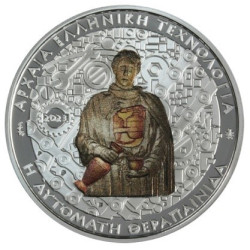
Ptolemy’s astrolabe (or spherical astrolabe) was an ingenuous astronomical instrument of antiquity. It simulated the celestial sphere and its revolution. Unlike solid celestial globes marking the positions of the major stars and constellations, it is an armillary sphere: the principal celestial circles (equator, ecliptic with the zodiac constellations, etc.) are represented by seven rings articulated together. The outer rings were used for adjusting to the observer’s meridian and latitude, while the inner rings were calibrated and equipped with sights. Thanks to the use of sights, Ptolemy’s astrolabe, in addition to serving as a common teaching tool, was also used as an instrument of observation for measuring and recording the coordinates of stars and planets. Although no such astrolabe has survived, Claudius Ptolemy (100-170 AD) described the instrument in detail in his Syntaxis mathematica or Megiste, known in the West as Almagest. The design of Ptolemy’s astrolabe on the obverse of the coin is based on a reconstruction by the Kotsanas Museum of Ancient Greek Technology.